

In industrial production, air compressors serve as core power equipment; their energy consumption accounts for 10% to 40% of total industrial energy usage. Under conditions of long-term, continuous operation, electricity costs often constitute over 60% of the equipment's operation and maintenance expenses. Consequently, energy conservation and consumption reduction have become a core imperative for enterprises seeking to control production costs and achieve sustainable, green development. As a national-level technology-oriented SME, Jiangxi Aisa Compressor Co., Ltd. leverages advanced German technology to specialize in the R&D and manufacturing of screw air compressors. Among its offerings, the two-stage screw air compressor has emerged as the preferred choice for numerous enterprises undergoing equipment upgrades, thanks to its significant energy-saving advantages. The core of this energy efficiency lies in its scientific structural design and technical optimization; the following section provides a detailed breakdown of its energy-saving principles.

I. Understanding the Core Premise: The Critical Link Between Compression Ratio and Energy Consumption
The primary function of an air compressor is to compress ambient air into the high-pressure gas required for industrial production. During this compression process, the higher the compression ratio, the greater the energy consumption—this constitutes the fundamental logical basis for the energy efficiency of two-stage compression systems. Traditional single-stage screw air compressors feature only a single pair of male and female rotors; after entering through the intake port, the air must be compressed in a single step to reach the target working pressure (e.g., 0.8 MPa). This results in a single-stage compression ratio as high as 8. This "one-step-to-completion" compression method leads to a drastic rise in discharge temperature, causing a significant amount of electrical energy to be wasted as heat. Simultaneously, it substantially reduces compression efficiency, accelerates equipment wear, and increases maintenance costs.
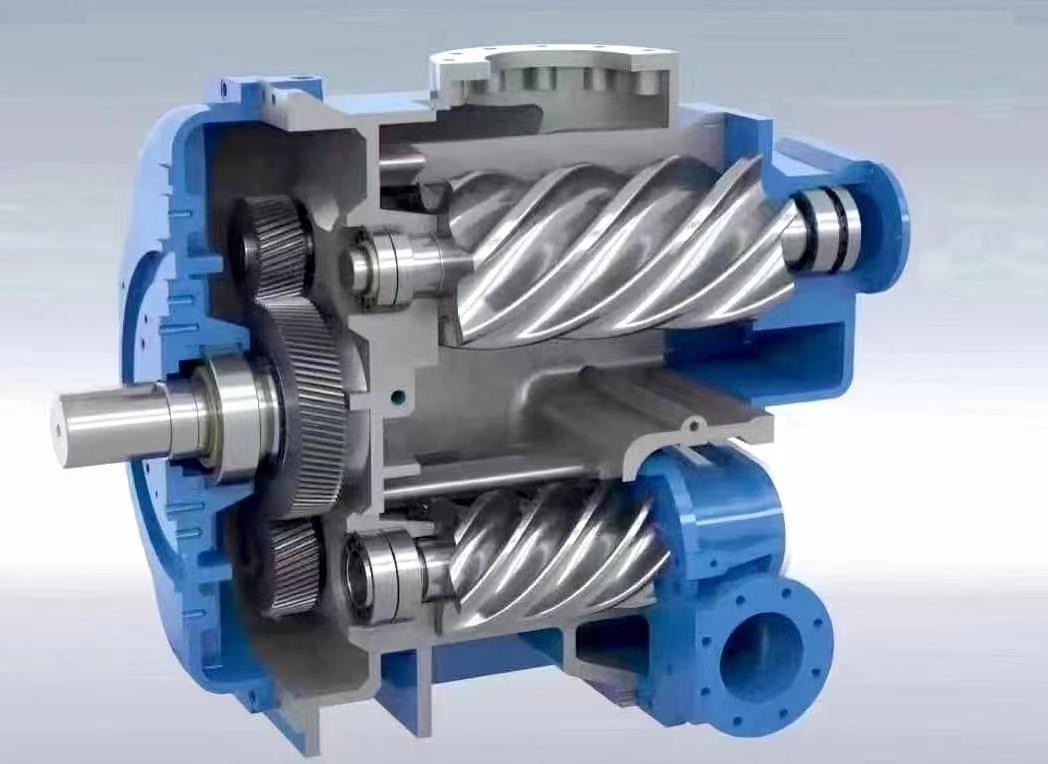
In contrast, the core breakthrough of the two-stage screw air compressor lies in splitting the "single high-pressure compression" process into "two stages of lower-pressure compression." By optimizing the compression workflow and reducing the compression ratio within each individual stage, energy loss is minimized at its very source. Furthermore, by integrating technologies such as inter-cooling and rotor optimization, the system achieves a doubling of energy efficiency. This is the fundamental reason why two-stage screw air compressors are able to save 15% to 20% more energy compared to their single-stage counterparts. II. Core Energy-Saving Principles: Three Key Design Features to Reduce Energy Consumption at the Source
(I) Staged Compression + Intercooling: Minimizing Thermal Energy Waste
According to the principles of engineering thermodynamics, isothermal compression represents the ideal state requiring the least amount of work during the air compression process. Although this ideal cannot be fully realized in actual production, two-stage compression—through its "staged compression + intercooling" design—maximally approximates this ideal state, thereby significantly reducing energy consumption. The specific process unfolds in three steps:
First-Stage Low-Pressure Compression: Air first enters the primary rotor, where it is compressed to a low-pressure state of 0.3–0.4 MPa. In this stage, the compression ratio is low (approximately 3), resulting in minimal energy consumption and reduced heat generation, thereby curbing energy waste at the source.
Intermediate Forced Cooling: The air, having undergone first-stage compression, is cooled down to a temperature close to ambient levels. As the temperature drops, the air density increases significantly; consequently, the energy required for the subsequent second-stage compression is substantially reduced. Simultaneously, this process prevents the decline in efficiency that would otherwise occur if high-temperature gas were to enter the second compression stage directly.
Second-Stage Precision Compression: The cooled, high-density air enters the secondary rotor, where it is compressed to the final pressure required for industrial production (e.g., 0.8 MPa or higher). At this point, the compression ratio for the second stage is approximately 2.67—remaining within a low-energy-consumption range—which further minimizes electrical energy loss.
(II) Precision Matching of Two-Stage Rotors: Enhancing Volumetric Efficiency and Minimizing Leakage Losses
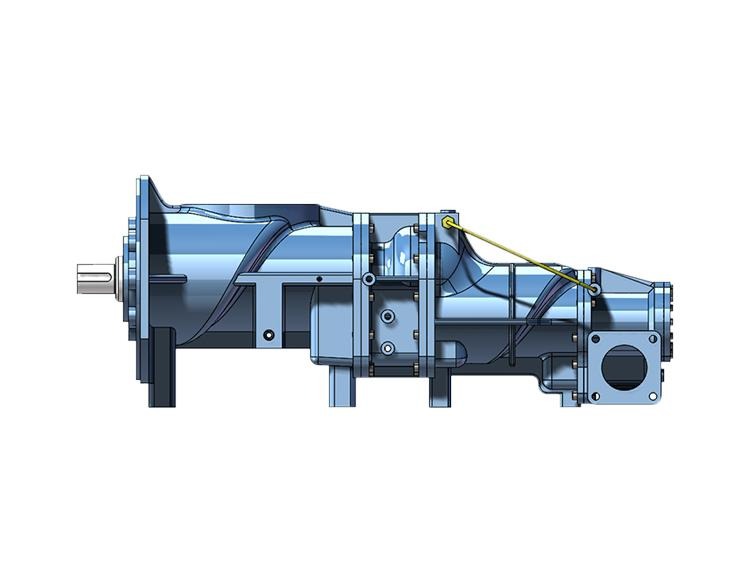
The core components of the Jiangxi Aisa two-stage screw air compressor—the rotors—are manufactured using advanced German processing technology, achieving a precision tolerance of up to 0.005 mm. Furthermore, specifically tailored to the characteristics of two-stage compression, the rotors undergo precise matching optimization: the primary rotor is designed to prioritize "high intake volume," ensuring an ample supply of incoming air to lay the foundation for efficient compression; conversely, the secondary rotor prioritizes "high compression efficiency," precisely matching the state of the gas exiting the first stage to minimize both internal and external gas leakage during the compression process.
Traditional single-stage rotors are required to simultaneously handle both "air intake" and "high-pressure compression," a dual mandate that often leads to issues such as excessive leakage and low volumetric efficiency. In contrast, the two-stage rotors feature a clear division of labor and operate synergistically, effectively boosting volumetric efficiency and further reducing wasteful energy consumption. Furthermore, the two-stage rotors are integrated within a single housing and driven directly via helical gears. This design ensures that each rotor stage achieves its optimal linear velocity, thereby enhancing compression transmission efficiency and minimizing energy losses during the transmission process.
(III) Powered by Permanent Magnet Synchronous Motors: Expanding the High-Efficiency Range and Enabling On-Demand Energy Supply
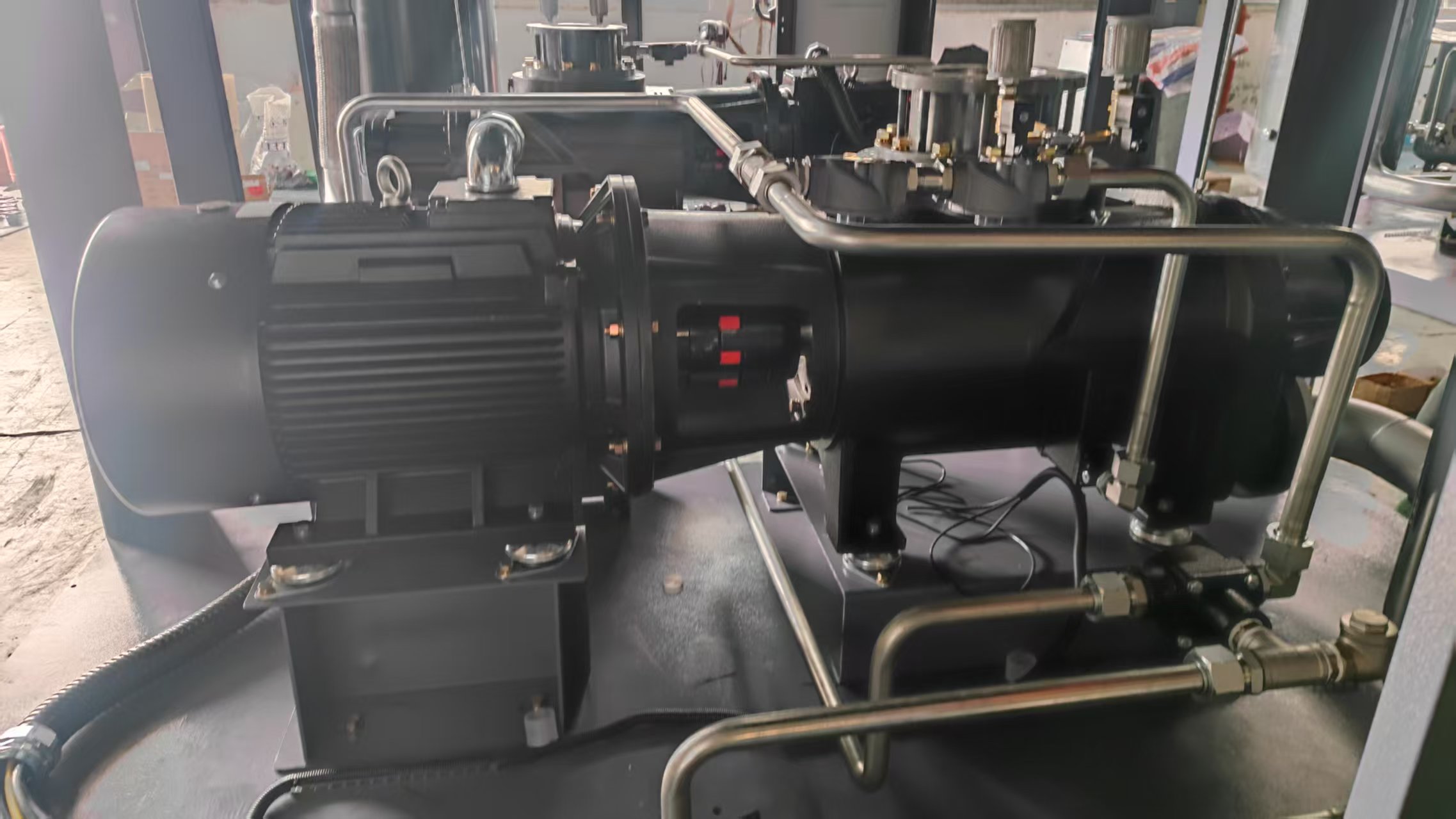
All Jiangxi Aisa two-stage screw air compressors are equipped with high-efficiency permanent magnet synchronous motors. Compared to traditional asynchronous motors, this feature significantly amplifies their energy-saving advantages. In permanent magnet synchronous motors, the magnetic field is generated by permanent magnets, eliminating the need for excitation current and thereby reducing excitation losses. With a power factor (cosφ) of ≥0.95, these motors maintain high efficiency across their entire rated speed range; in contrast, traditional asynchronous motors operate efficiently only near their rated speed, with efficiency dropping to a mere 50%–70% at lower speeds.
By integrating variable frequency control technology, the equipment can automatically adjust its rotational speed based on the facility's actual air demand. When air demand fluctuates significantly (by more than 30%), the motor speed adjusts synchronously with the demand. This eliminates a major drawback of traditional air compressors—namely, that they continue to consume 30%–50% of their rated power even when running under no-load conditions. For instance, when air demand drops from 10 m³/min to 5 m³/min, the motor speed decreases accordingly, thereby lowering energy consumption. This truly realizes the goal of "on-demand energy supply" and completely eliminates wasteful energy consumption.
III. Two-Stage Compression: More Than Just Energy Savings—It’s a Long-Term Investment
The energy-saving benefit of two-stage screw air compressors does not stem merely from the presence of "an extra rotor." Rather, it is the result of a scientifically engineered design featuring "staged compression combined with inter-cooling." By integrating this design with precise rotor matching, the support of permanent magnet synchronous motors, and meticulous optimization of details, the system fundamentally reduces energy losses during the compression process, thereby achieving the operational objectives of "energy efficiency, high performance, low consumption, and stability."
With a core focus on "reducing energy consumption, enhancing efficiency, and extending service life," Jiangxi Aisa remains deeply committed to the field of screw air compressors. By seamlessly blending advanced German technology with its own robust R&D capabilities, the company ensures that the energy-saving advantages of two-stage compression are fully realized and implemented, providing cost-effective compressed air solutions to industrial enterprises worldwide. Choosing the Jiangxi Aisa two-stage compression screw air compressor means selecting not merely a highly efficient and energy-saving piece of equipment, but a long-term, economical, and eco-friendly production model—one that empowers enterprises to advance steadily on the path toward cost reduction and efficiency enhancement.

