

In-depth Analysis of Screw Air Compressor Technical Parameters
At the "heart" of industrial manufacturing, screw air compressor, with compressed air as their "blood," continuously supply power to the production line. Their technical parameters are not only a "health check report" of equipment performance, but also a key to cost reduction, efficiency improvement, and green transformation for enterprises. From the stringent requirements of high-pressure, precise air supply in laser cutting workshops to the zero-tolerance requirements of compressed air cleanliness in food processing plants; from the expectation of mobile equipment withstanding harsh environments in mining operations to the ultimate pursuit of low-noise operating environments in laboratories—the five core parameters of discharge pressure, flow rate, temperature, noise level, and cooling method are collectively outlining a clear path for the technological upgrade of screw air compressor.
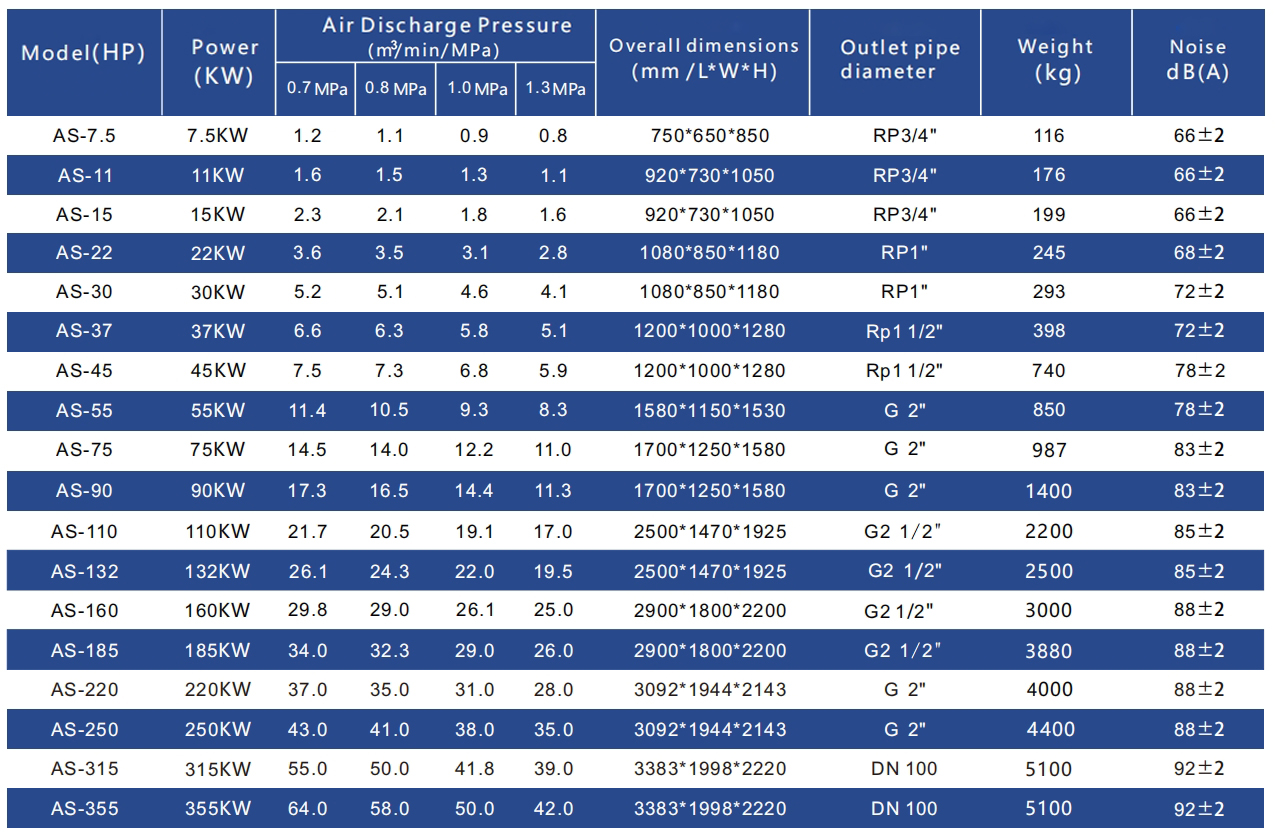
Discharge Pressure: Precisely Adapting to Different Scenarios
The discharge pressure of screw air compressor is usually measured in megapascals (MPa) or bar, with mainstream models covering a range of 0.7-1.3 MPa. For example, in conventional industrial applications, a pressure of 0.7-0.8 MPa can meet 90% of the air demand, while scenarios such as laser cutting and precision manufacturing require high-pressure models above 1.0 MPa. Taking a 15KW single-phase variable frequency screw air compressor as an example, through a single-stage compression design, it can output a flow rate of 2.1 m³/min at 0.8 MPa. For every 0.1 MPa increase in pressure, the flow rate decreases by approximately 8%, demonstrating a dynamic balance between pressure and flow. Some high-end models adopt two-stage compression technology, reducing the single-stage compression ratio through interstage cooling, and can still maintain efficient operation at a high pressure of 1.3 MPa, suitable for heavy-duty scenarios such as chemical and metallurgical industries.
Flow Rate Parameter: A Dual Test of Efficiency and Stability
Flow rate (unit: m³/min) is the core indicator for measuring the air compressor's air production capacity. Industry standards require that the actual flow rate of the equipment under rated operating conditions must not be less than 95% of the nominal value. Taking a 22KW permanent magnet variable frequency screw air compressor as an example, it adopts single-stage oil-injected screw technology and can still stably output a flow rate of 2.8m³/min under 13bar high pressure, meeting the continuous air supply needs of field operations such as mining and infrastructure construction. Some manufacturers have significantly improved air supply stability by optimizing the rotor profile and intake system, controlling flow fluctuations within ±2%.
Temperature Control: The Critical Point Between Safety and Energy Efficiency
The operating temperature of a screw air compressor directly affects equipment lifespan and energy efficiency. Industry standards stipulate that the exhaust temperature must not exceed 110℃, and the temperature before oil-gas separation must be higher than the pressure dew point to prevent condensation. For example, two-stage compressor models, through interstage cooling design, reduce the single-stage compression ratio by 40%, lowering the exhaust temperature by 15℃ compared to traditional models, resulting in annual energy savings of over 20,000 KWh. Furthermore, intelligent temperature control systems can monitor lubricating oil temperature in real time and automatically adjust the cooling fan speed to ensure the temperature remains stable within the optimal range of 60-80℃, extending the lifespan of bearings and seals.
Noise Level: A Technological Breakthrough from "Noise Reduction" to "Silence"
The noise of screw air compressor mainly originates from intake, exhaust, and mechanical vibration. Industry requirements stipulate that the noise level at 1 meter should be ≤85dB(A). To reduce noise, multiple technical measures are employed:
Acoustic Optimization Design: By optimizing the intake muffler, exhaust muffler, and overall sound insulation enclosure, noise is reduced by 10-15dB(A).
Variable Frequency Control Technology: By adjusting the motor speed, mechanical vibration is reduced, lowering the noise peak. Actual measurement data shows that variable frequency models reduce noise by 20% compared to fixed frequency models under low load conditions, while also saving over 30% in energy.
Vibration Damping and Isolation Measures: Rubber vibration damping pads or sound insulation cotton are installed on the equipment base to block vibration transmission paths and further reduce noise radiation.
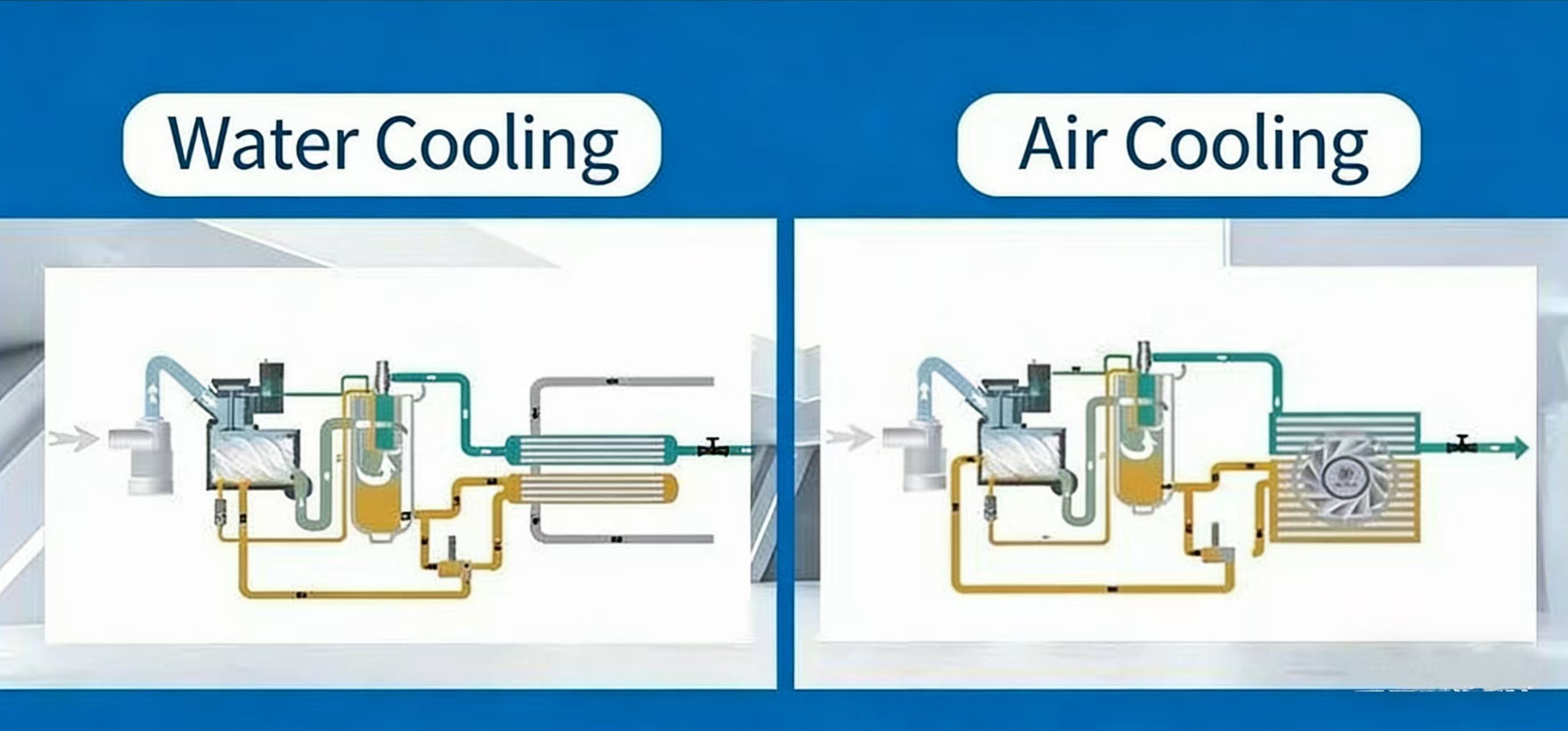
Cooling Method: Compatibility Selection Between Air Cooling and Water Cooling
The cooling method directly affects the operating efficiency and environmental adaptability of an air compressor. It is mainly divided into two categories: air cooling and water cooling.
Air Cooling System: This system uses a fan to force air circulation for heat dissipation. It has a simple structure, low maintenance costs, and is suitable for environments with temperatures ≤40℃ and good ventilation. For example, mobile air compressors often use air cooling designs for easy deployment in the field. However, air-cooled models are prone to insufficient heat dissipation in high-temperature or high-humidity environments, leading to excessive exhaust temperatures. Therefore, it requires a larger heat dissipation area or intelligent temperature-controlled fans.
Water Cooling System: This system uses circulating cooling water to remove heat. It has high heat dissipation efficiency and is suitable for high-temperature, high-humidity, or continuous high-load operation scenarios. For example, a chemical company uses a water-cooled screw air compressor, which can still operate stably at an ambient temperature of 45℃. The cooling water can be recycled for use in other processes, achieving comprehensive energy utilization. However, water-cooled models require a cooling tower and water piping, resulting in higher initial investment and maintenance costs.
Industry Trends: Parameter Collaborative Optimization Drives Technological Upgrades
With the advancement of the "dual carbon" goals, the technical parameters of screw air compressor are evolving towards higher efficiency, intelligence, and greener operation. The integration of technologies such as two-stage compression, permanent magnet variable frequency, and IoT monitoring enables equipment to maintain low specific power (≤5.2KW/m³/min), low noise (≤75dB(A)), and efficient cooling performance even under high pressure and high flow conditions. For example, high-end models, through the integration of intelligent control systems, can monitor pressure, flow, temperature, and noise parameters in real time, automatically adjusting operating modes to achieve an overall energy efficiency improvement of over 20%. In the future, with the growing demand in emerging fields such as hydrogen compression and carbon capture, the technical parameters of screw air compressor will further develop towards adaptability to extreme operating conditions and low carbon emissions throughout their entire life cycle.

